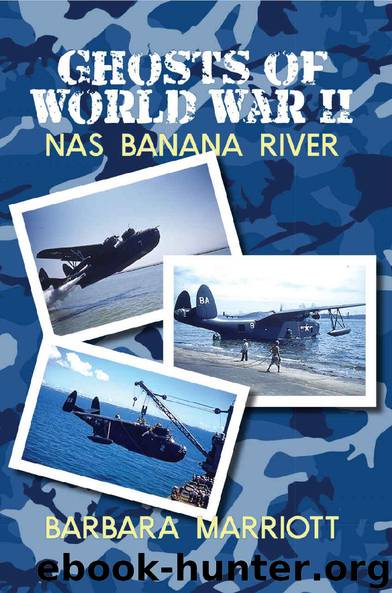
Ghosts of World War II: NAS Banana River by Barbara Marriott
Author:Barbara Marriott [Marriott, Barbara]
Language: eng
Format: epub
Publisher: Fireship Press
Published: 2018-07-03T23:00:00+00:00
THE WAR POWER OF NAVAL AVIATION
The SNB. Used for training by the Air Bombers Training Unit
Photo: San Diego Air and Space Museum
The F4F fighter plane
Photo: San Diego Air and Space Museum
PBY training plane and a Navy search blimp
Photo: San Diego Air and Space Museum
The crash of an F4F
Photo: San Diego Air and Space Museum
CHAPTER SEVEN
1944
Daily Mail, January 17, 1944
EISENHOWER ARRIVES IN LONDON HQ
Daily Herald, May 25, 1944
ENEMY IN FLIGHT FROM HITLER LINE
Rockford Morning Star, June 6, 1944
ALLIES INVADE EUROPE, LAND ON FRENCH COAST
Evening Standard, June 6, 1944
4000 SHIPS, THOUSANDS OF SMALLER VESSELS SHELLED BY 640 GUNS
Chicago Sunday Tribune, July 23, 1944
SMASH BACK JAPS ON GUAM
Chicago Daily Tribune, August 11, 1944
MACARTHUR HITS PHILIPPINES
Chicago Daily Tribune, October 20, 1944
NAVY ATTACKS MANILA AREA
Altoona Mirror, October 26, 1944
JAP SEAPOWER KNOCKED OUT, 30 ENEMY WARSHIPS SUNK OR DAMAGED IN MOST DECISIVE NAVAL ENGAGEMENT OF WAR
Daily Mail, December 29, 1944
PATTON'S 3rd ARMY STRIKES AT "BULGE" FROM SOUTH
Preparing for Invasion
Rumors had circulated for months—the big invasion was coming. Signs were everywhere. The newspaper headlines shouted Eisenhower’s arrival in England, from which location he was to lead the invasion. In the Pacific, Navy forces were attacking multiple targets, sea battles with the Japanese were raging, and America’s forces were winning.
No one knew when or where the anticipated invasion would be. Smart money was on Calais because of its proximity to England. Others believed it would be the French Riviera, close as it was to Africa. But one thing was certain. Copious amounts of equipment were being demanded.
Factories, manned by draft-deferred men, along with a huge labor force of women, were running three shifts a day, seven days a week. Providers of natural resources found themselves toiling on the same demanding schedules. A mighty, powerful industrial nation had been created, and it was producing.
But equipment, even in large amounts and crafted using the latest technologies, was useless without expert men to utilize it. To answer the need for manpower, the draft pulled in more and more male citizens. Categories of deferment changed; men in their thirties and married men without children found themselves in the military.
Jake was not privy to the invasion plans, but headquarters had told him to expect an increase in students in BRNAS’s three major training units: PBM crew training, navigation school, and the fairly new air bombers group.
Jake’s orders were explicit: his command was responsible for the training and preparation of sailors for war, and the release of an everescalating number of shore-based sailors to the combat zones.
The Marines had been supplying fresh combat-trained men to the front since the beginning of the war. From the day of its arrival at Banana River, the Marine Company at Banana River had a policy of sending its inexperienced men to combat school as soon as a billet opened. These men were replaced with marines returning from the war zones. The Navy began replacing its shore-duty sailors either with civilian personnel or with WAVES.
The WAVES Arrive
Jake Gorton had been asked in 1942 to recommend that area WAVES be assigned to his command.
Download
This site does not store any files on its server. We only index and link to content provided by other sites. Please contact the content providers to delete copyright contents if any and email us, we'll remove relevant links or contents immediately.
| Africa | Americas |
| Arctic & Antarctica | Asia |
| Australia & Oceania | Europe |
| Middle East | Russia |
| United States | World |
| Ancient Civilizations | Military |
| Historical Study & Educational Resources |
The Radium Girls by Kate Moore(12033)
100 Deadly Skills by Clint Emerson(4929)
Rise and Kill First by Ronen Bergman(4793)
The Templars by Dan Jones(4690)
The Doomsday Machine by Daniel Ellsberg(4492)
The Rape of Nanking by Iris Chang(4218)
Killing England by Bill O'Reilly(4006)
Stalin by Stephen Kotkin(3971)
Hitler in Los Angeles by Steven J. Ross(3947)
12 Strong by Doug Stanton(3553)
Hitler's Monsters by Eric Kurlander(3346)
Blood and Sand by Alex Von Tunzelmann(3206)
The Code Book by Simon Singh(3196)
Darkest Hour by Anthony McCarten(3134)
The Art of War Visualized by Jessica Hagy(3012)
Hitler's Flying Saucers: A Guide to German Flying Discs of the Second World War by Stevens Henry(2757)
Babylon's Ark by Lawrence Anthony(2684)
The Second World Wars by Victor Davis Hanson(2528)
Tobruk by Peter Fitzsimons(2520)
